

How to prepare your manuscript for publishers – guidelines every writer needs to know
Many talented writers have their work rejected simply because they don’t follow the standard guidelines set out in the publishing industry.
The requirements offered here are to be used as general information only. It’s the writer’s responsibility to check and follow individual publisher’s guidelines prior to sending work to them.
Standard formatting and submission guidelines
Documents must be presented with a professional look. It’s nice to know somethings haven’t changed, and as of 2026, the standard requirements often adopted by many publishers remain as:
- 12 pt font size
- Times Roman for the font
- 1.5 to double spacing (usually double spacing is preferred)
- left aligned (ragged right, meaning not justified)
- black text on white background (no additional colours at all, that includes headings)
- A4, which is 29.7 cm x 21.0 cm (Australian standard).
- No borders or anything else in an attempt to personalise or beautify it.
Many publishers in Australia now accept manuscripts via email or dedicated online portals, but check the individual publisher that you are intending to send your manuscript to for preferred submission methods.
Although, there are still some publishers who accept manuscripts as hard copies. If this is the case, then here are some additional guidelines, but (as always) check with the intended publisher for their preferences:
- single sided (meaning use one side of a page only)
- A4, 80 gsm, white paper (make sure it’s clear of dirty smudges, food particles, etc.)
- If your work contains many pages and the publisher’s preference is for the complete manuscript to be submitted, then secure the pages with an appropriately sized elastic band around the middle. If your submitted work contains fewer pages where an elastic band would cause it to curl or tear, then use a single paperclip on the left-hand corner. Don’t bind your documents professionally or by any other means (including stapling, gluing, or within plastic pockets presented in a folder of any description).
How do I work out how many words are in my manuscript?
To obtain the correct word count in Word, go to the Review tab, click on Word Count. In the sample shown below, there are 6,127 words. This is the figure that needs to be recorded when specifying the total word count.
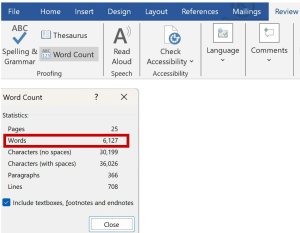
If you cannot see the image clearly, it has been provided here (Word count sample) as a PDF.
Standard presentation of the cover page and manuscript pages
Don’t waste your time trying to create a pretty cover – you’re a writer and that’s not your job. Besides, the publishing house will organise that part of the procedure along with other marketing aspects after your work has been accepted. At which time you can share your ideas as to how you see a cover, but remember that it’s ultimately the publishing house’s decision. They are in the business of selling books and have been doing so for many years. They back this knowledge with spending a great deal of money to print the end product, market it, and pay the author (including advances). In other words, learn from them; don’t annoy them. If you want to own all decisions relating to design and marketing, then perhaps the publishing houses is not for you, and you might want to consider self-publishing your manuscript instead if you have the funds to do so.
The front cover should contain the title of the work and the author’s name centred and in the middle of the page. The wordage is displayed on the bottom right-hand corner, and the type of work (e.g. short story) on the top left-hand corner. That’s it. If you have something else to say, then leave it for the accompanying letter.
Each page of your manuscript should have the title of the work and the author’s name along the top of the page. Insert it as a header for Microsoft Word documents. Number each page, this can be presented on the top right-hand corner (use the header again) or on the bottom and centred (use the footer in Microsoft Word documents).
For Australian publishers, make sure your page is set up for Australian size A4 (29.7 cm x 21.0 cm). Some default settings on computers or printers may produce letter size, so make sure you use the A4 sizing, which shouldn’t be confused with the American A4 standard size.
Dealing with publishers
While publishers have their own guidelines in regards to how they should be contacted, we hope this information is helpful. Don’t forget to check the intended publisher’s website for guidelines before submitting your work. We realise that we have mentioned that several times already, but it is important. Incorrect submission methods could cause your work to be tossed in the slush pile. A slush pile comprises of rejected manuscripts. Some manuscripts that end up there haven’t even been read; they may have been tossed in simply for not using the right font. Remember: a quick glance from a publishing house’s employee could depend on whether your work is read or not, so make sure you follow their guidelines.
Publishers receive thousands of manuscripts every week, naturally they will want to ‘thin the herd’ and what better way than to toss every manuscript that doesn’t fit their basic requirements?
Try to obtain the submissions manager or editor’s name, and make sure you spell it correctly. Don’t make a nuisance of yourself in this attempt. If you do end up calling the publisher, then ask the receptionist for the correct details, but this should be a last resort.
If the publishing house accepts hard copies sent to them through Australia Post, do not hand deliver it; you won’t receive extra points for your troubles. It actually might work against you. Oddly enough, they don’t want to see the eager faces of hopeful writers without an invite. And don’t call to make an appointment either. Publishing houses are extremely busy, and that includes the receptionists, so be mindful.

